 Showrooms
  Call us:


A practical guide to choosing between LVT and sheet vinyl for healthcare flooring specifications
When comparing LVT vs sheet vinyl healthcare flooring, neither system is automatically the right choice for every clinical environment. Sheet vinyl can be more appropriate where continuously bonded, welded or coved finishes are required, while rigid core LVT can offer advantages in suitable non-specialist spaces where refurbishment speed, acoustic performance, repairability and reduced disruption are priorities.
The better approach is to specify by clinical zone. Hygiene, traffic, cleaning, acoustics, installation conditions and expected service life should all inform the decision.
LVT or Sheet Vinyl? Start With the Healthcare Environment
Healthcare flooring is rarely a simple choice between two materials. What matters is what the floor actually needs to do in the space where it’s being installed.
A hospital corridor, consultation room, waiting area and operating theatre may all sit within the same building, but the demands placed on their floors can be very different. That’s why both LVT and sheet vinyl can have a place within a healthcare flooring specification.
Before comparing products, it’s worth considering the requirements of each clinical zone:
- Traffic levels: Will the floor experience frequent footfall, trolleys, beds or wheeled equipment?
- Cleaning requirements: What cleaning products, methods and frequencies will be used?
- Hygiene detailing: Are welded seams, coved edges or a continuously bonded finish required?
- Acoustic performance: Could impact sound from footsteps, equipment or movement affect patients or staff?
- Installation conditions: Does the building need to remain operational during refurbishment?
- Future maintenance: How easily can damaged areas be repaired or replaced?
- Moisture exposure: Will the floor be exposed to spills, wet cleaning or higher humidity?
For architects and interior designers, the comparison therefore needs to go beyond appearance and initial material cost. Cleaning regimes, wheeled traffic, acoustic performance, repairability, moisture, installation time and future replacement all have a bearing on whether a specification will continue to work once the building is occupied.
It’s also important to assess the floor as a complete system. Subfloor condition, joints, thresholds, perimeter details and transitions to adjoining finishes can all influence performance. A material that looks suitable in isolation may not be right if the installation method or detailing doesn’t meet the needs of the space.
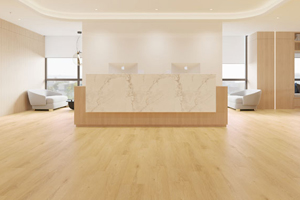
Rigid core LVT, including Impervia products designed for demanding commercial applications, can provide an alternative in suitable patient, staff and public-facing spaces. More detail on the range and its application can be found within Impervia’s Healthcare Flooring Solutions.
That doesn’t mean rigid core LVT should simply replace sheet vinyl throughout a healthcare project. Operating theatres, clean rooms and other specialist controlled environments can require very specific flooring systems, detailing and cleaning protocols. In practice, the most effective specification may use different flooring solutions across different areas, based on the clinical, operational and maintenance requirements of each zone.
What Is the Difference Between LVT and Sheet Vinyl in Healthcare?
The main difference isn’t simply how the two materials look. It’s how they’re constructed, installed, detailed and repaired.
Sheet vinyl is supplied in rolls and is normally bonded directly to the prepared substrate. Joints can be welded and the flooring can be coved up walls where the specification calls for a more continuous finish.
Rigid core LVT is modular, using individual planks or tiles. Impervia uses a rigid composite stone construction with integrated IXPE acoustic backing, creating a different build-up and installation approach to traditional bonded vinyl.
| Consideration | Sheet Vinyl | Rigid Core LVT |
|---|---|---|
| Format | Large rolls | Individual planks or tiles |
| Installation | Typically bonded to the substrate | Modular click or push-fit system |
| Joints | Can be welded | Individual interlocking boards or tiles |
| Repairs | Damaged areas may require cutting and specialist repair | Individual boards can potentially be replaced |
| Acoustic build-up | Depends on specified product and system | Acoustic backing can be incorporated into the product |
| Refurbishment | Preparation and bonding requirements need to be programmed | Can offer practical advantages where disruption needs to be reduced |
| Typical applications | Clinical areas requiring specialist detailing | Suitable non-specialist patient, staff and public areas |
It can be tempting to reduce the healthcare LVT vs vinyl sheet comparison to the number of joints in the finished floor. In practice, that’s too simplistic.
Cleaning methods, moisture exposure, clinical risk, perimeter details, traffic and maintenance all matter. A properly considered healthcare flooring comparison needs to look at the complete system rather than one feature in isolation.
How Do Installation and Refurbishment Requirements Compare?
Installation becomes particularly important when flooring for healthcare refurbishment is being specified in a building that needs to stay operational.
Traditional sheet vinyl generally requires a prepared substrate, adhesive application and careful installation of seams, edges and any coved details. Where welded joints or specialist detailing are required, these are valuable elements of the specification, but they also need to be allowed for within the programme.
Rigid core LVT takes a different approach. Impervia’s push-fit system can reduce some of the installation complexity associated with bonded flooring, which can be useful where rooms need to return to service efficiently.
That doesn’t mean rigid core flooring is preparation-free.
Existing substrates still need to be assessed for condition and flatness. Floor heights, door clearances, thresholds, transitions and connections with adjoining finishes should all be reviewed before either system is specified.
Those details matter even more in an occupied hospital, care environment or clinic. Taking a corridor, waiting room or patient area out of service can affect far more than the flooring contractor’s programme. Staff routes, patient movement and access to adjoining spaces may all be affected.
That’s why installation methodology isn’t simply a contractor consideration. It can become part of the operational case for one flooring system over another.
How Do Maintenance, Repairability and Lifecycle Costs Compare?
The initial flooring price only tells part of the story.
Healthcare flooring lifecycle costs can include substrate preparation, installation, routine cleaning, repairs, disruption, replacement and the operational consequences of closing an area while remedial work is completed.
This is one area where modular flooring can offer a practical advantage.
If an individual rigid core LVT board becomes damaged, products such as Impervia allow localised board replacement rather than automatically requiring a much larger section of the floor to be lifted. In a live healthcare environment, that can make repairs considerably more manageable.
Sheet vinyl has clear maintenance strengths too. A correctly specified and installed sheet floor can provide a straightforward surface for routine cleaning, particularly where welded seams and coved details form part of the clinical requirement.
The distinction becomes more apparent when damage occurs. Repairing a damaged section of sheet vinyl, particularly where welded joints or specialist detailing are involved, can require a more involved local repair.
For hospitals, clinics and care settings, there’s also an indirect cost to consider. If a room or corridor needs to close for flooring repairs, the disruption to staff and patients may be more significant than the material cost itself.
That’s why value engineering should look at the whole life of the installation. The lowest upfront figure isn’t necessarily the lowest-cost specification once maintenance, repairability and operational disruption are taken into account.
How Do Hygiene, Acoustics and Clinical Suitability Differ?
Healthcare hygiene can’t be judged by the surface material alone.
The complete installation matters, including joints, edges, transitions, perimeter details and compatibility with the cleaning regime used within the building.
This is where sheet vinyl retains an important role. In healthcare areas where welded seams, coving or continuously bonded construction are specifically required, an appropriate sheet system may offer the most suitable solution.
The NHS Health Building Note 00-10 Part A: Flooring provides useful reference material when considering flooring performance and detailing within healthcare environments.
Acoustics create another distinction.
Rigid core LVT can incorporate acoustic backing within the flooring construction. Selected Impervia products provide impact sound reduction of up to 21dB, subject to the exact product specification and test data.
That can be particularly relevant in patient accommodation, consultation spaces and circulation areas. Background noise from footfall, trolleys and general movement can contribute to the overall acoustic environment, so flooring should be considered alongside the wider acoustic design rather than purely as a visual finish.
The same evidence-led approach should apply to every performance claim. Before final specification, architects should review technical information for the exact proposed product, including slip performance, acoustic testing, cleaning compatibility, expected traffic levels and indoor air quality credentials.
Generic descriptions such as “healthcare grade” or “commercial grade” aren’t a substitute for product-specific evidence.
When Is Rigid Core LVT the Better Healthcare Specification?
Rigid core LVT becomes particularly relevant where refurbishment practicality, localised repairs, acoustic performance and commercial durability carry significant weight.
That can make it a strong option across a range of non-specialist healthcare environments, but the decision still needs to be made by application.
| Healthcare Area | Likely Specification Considerations | Potential Flooring Direction |
|---|---|---|
| Waiting areas and receptions | High footfall, appearance, maintenance, acoustics | Rigid core LVT may offer strong advantages |
| Consultation rooms | Cleaning, comfort, maintenance, refurbishment | Rigid core LVT may be appropriate |
| Patient accommodation | Acoustics, cleaning, wheeled furniture, comfort | Assess rigid core LVT against project requirements |
| Staff and administrative areas | High use, maintenance, retrofit practicality | Rigid core LVT can be well suited |
| Corridors | Heavy traffic, rolling loads, cleaning and repair | Assess exact product and traffic requirements |
| Operating theatres and clean rooms | Strict hygiene, specialist detailing and cleaning | Specialist continuously bonded systems may be more appropriate |
Impervia combines waterproof construction, a commercial-grade wear surface, integrated IXPE backing and a push-fit installation system. Together, those characteristics can make it particularly useful for appropriate refurbishment projects where installation practicality and long-term maintenance matter.
The key word is appropriate.
Commercial LVT healthcare flooring shouldn’t be treated as a universal replacement for sheet vinyl. Equally, sheet vinyl shouldn’t be specified throughout an entire healthcare facility simply because it’s traditionally been associated with clinical environments.
For each area, the project team should consider:
- What is the clinical risk of the space?
- What cleaning regime will be used?
- Will the floor experience regular rolling loads?
- What moisture exposure is expected?
- Is there an acoustic performance requirement?
- What is the condition and construction of the subfloor?
- How disruptive can installation or future repair work be?
- What product-specific testing and certification are required?
These questions provide a much stronger basis for specification than selecting by material category alone.
Which Flooring Should You Specify?
The LVT vs sheet vinyl for hospitals discussion is ultimately about matching the flooring system to the way each part of the building will operate.
Sheet vinyl retains clear advantages where specialist hygiene requirements call for welded seams, coving or continuously bonded installation.
Rigid core LVT can provide a strong alternative in appropriate corridors, waiting areas, consultation rooms, patient accommodation and staff spaces where acoustic performance, installation practicality and localised repairability are important.
In many projects, the strongest specification won’t involve choosing one material for the entire building. It may use more than one type of hospital flooring material, with each selected for the demands of the space.
Rather than relying on generic claims, architects, contractors and designers should review technical evidence for the exact proposed flooring against the clinical requirements of each zone.
For support comparing rigid core LVT with the practical requirements of your project, explore Impervia’s Healthcare Flooring Solutions and Discuss Your Healthcare Flooring Specification with the team.
 Showrooms
 Call us: